IS TRADITIONAL SILT FENCING STILL THE BEST OPTION FOR YOUR CURRENT PROJECT?
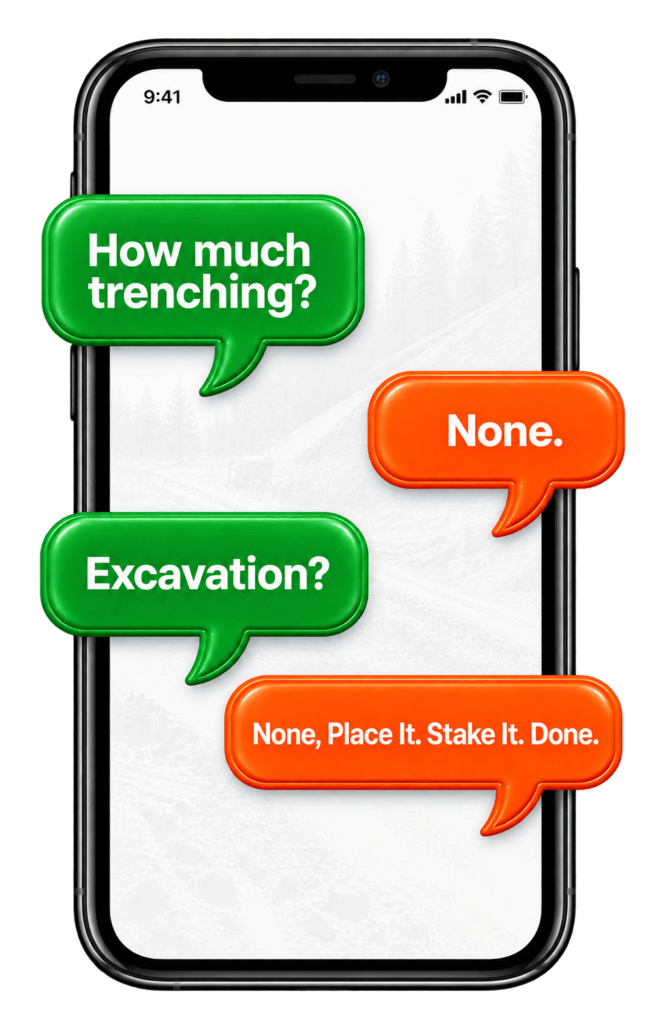
Traditional silt fencing requires trenching, excavation and considerable labour. It disrupts existing soil and roots, can separate from uneven ground and frequently requires repairs throughout the project. Every damaged or poorly seated section creates more maintenance, more labour and another opportunity for sediment-laden runoff to escape.
Every phase of a build brings new runoff risks, and as your project grows, your protection needs to grow with it. Fisher Sediment Barrier picks up and moves with the work, so your sediment control keeps pace with your crew at every stage.
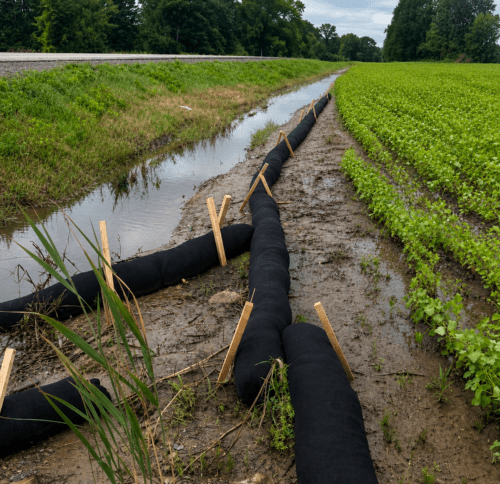
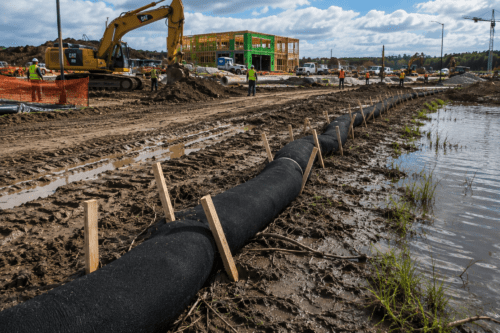
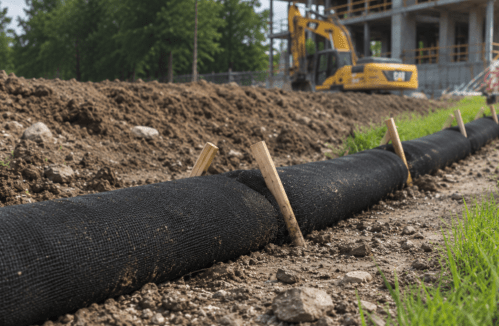
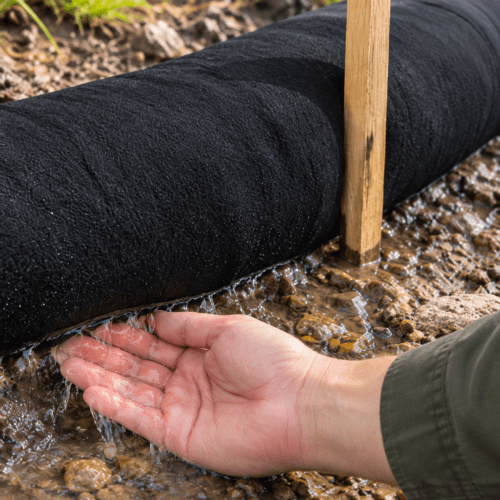
Fisher Sediment Barrier is a flexible, round filtration system made with durable knitted mesh and natural wood-fibre media that helps slow runoff and capture sediment before it leaves your site. Its flexible design follows slopes, uneven ground, and changing site conditions, making installation easier without excavating or disturbing existing root systems.
Fisher Sediment Barrier, is intentionally filled with natural wood chips that are 99.2 % biodegradable unlike the plastic materials other sediment products are made with. This offers a more environmentally conscious approach to erosion and sediment control and when coupled with an biochar option and limited footprinted it represents a definite step forward in sustainable sediment management.
Easy to reposition as work progresses, it provides adaptable sediment control throughout each stage of construction. Less disruption, natural materials, and dependable protection make Fisher Sediment Barrier a smarter choice for demanding construction sites.
START SOONER (No Trenching)
FINISH FASTER (No Backfill)
Less Labour Intensive For Staff
Easier Inspections
Bid More Jobs
Stop Chasing Repairs
Protect What's Downstream
Eco-Smart by Design
Keeps sediment on your site and out of waterways, drains and natural areas.
“It’s in the design. It’s what you DON’T have to do but that is only part of the story. Fisher Sediment Barrier was engineered to provide effective erosion and sediment control while supporting the environment in an easier way than has been traditionally known – a better option. It does that by following the natural contours of the terrain while its wood-chip filtration media intercepts and captures displaced sediment—delivering effective filtration without fighting the landscape.
Hidden Environmental Risks: Construction runoff carries more than sediment. Silt fence fabric can become a reservoir of concentrated pollutants, retaining layers of fine sediment, heavy metals, petroleum products, grease, and chemical residues. When these fences are dismantled or improperly handled, accumulated contaminants can be released back into the surrounding soil and waterways, the very environment they were installed to protect.
PROTECTS WATERWAYS
Helps capture sediment before it reaches creeks, rivers, stormwater systems and other receiving waters
KEEPS SOIL ON SITE
Retains displaced soil within the project area instead of allowing valuable material to wash away with runoff.
REDUCES SEDIMENT MIGRATION
Helps prevent sediment from travelling onto roads, neighbouring properties and surrounding areas.
Protects Drainage Systems
Helps keep sediment out of catch basins, culverts and drainage infrastructure.
Habitat Disruption During Removal: Traditional silt fencing requires fabric to be buried approximately four inches below the soil surface, creating the potential for further environmental damage during removal. Pulling embedded fabric from the ground can uproot regenerating vegetation, tear through developing root systems, and disturb recovering soil, creating a second wave of environmental disruption long after construction activities have ended.
—With less environmental disruption and significant savings in time, labour, and installation costs, the benefits go far beyond sustainability — it’s a smarter financial investment.
Applications
Built for Demanding Worksites
Fisher Sediment Barrier . Multiple Applications. Capture More. Disturb Less.
Real Projects. Real Conditions. Measurable Performance
Flow through Rates
Keener, Faucette & Klingman, 2007
This is one of the better direct comparisons between compost filter sock and silt fence. It looks at flow-through rates, solids separation, ponding, and performance compared to traditional silt fence. The key takeaway is that compost filter sock can provide comparable sediment/solids control while allowing more controlled flow-through and reducing some of the ponding/overtopping pressure that can occur behind silt fence.
Keener, Faucette & Klingman, 2007Faucette et al., 2008
This is a USDA ARS summary of a study comparing compost filter socks and silt fence under simulated storm runoff. The important point is that compost filter sock and silt fence showed very similar removal efficiencies for total suspended solids and turbidity, and filter socks with flocculants showed even higher sediment removal efficiencies